





 Download Summary
 Download Full Report
Policy Priorities for the Global Labor Market Transition to the Capability Economy
Ahmad Al-Yamani, Jude Althagafi, and Leena Ghandourah
Labor market systems assume that most people have a stable job with an identifiable employer. That relationship supports social insurance, payroll taxes, worker protections, and employment statistics. But work is becoming fragmented, platform-mediated, cross-border, and AI-augmented. As the job becomes a less reliable unit for organizing economic life, the institutions built around it lose their fit. Systems for measuring, protecting, developing, and taxing work are changing more slowly than work itself.
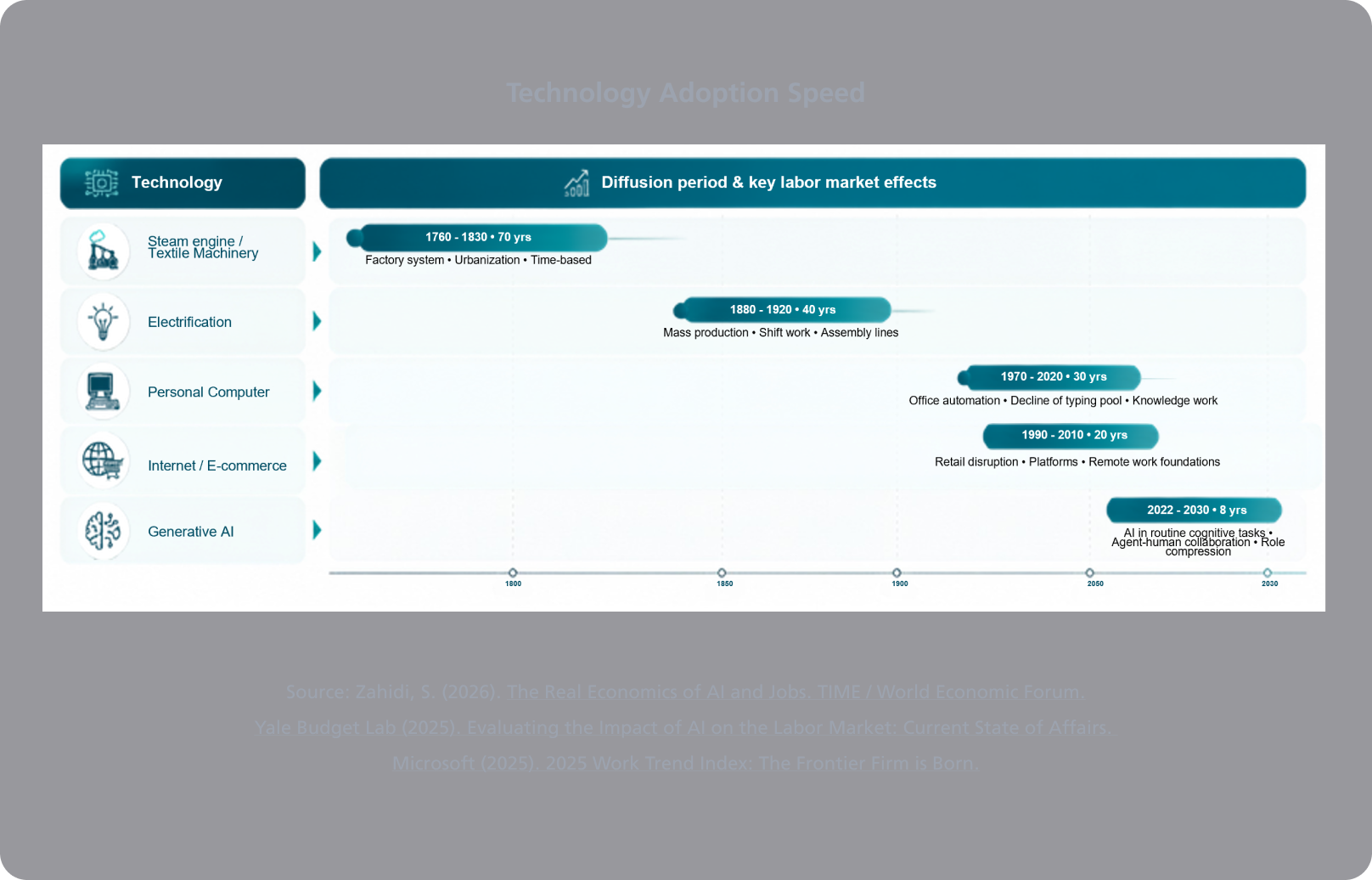
For most of history, work was personal and outcome based, organized around demonstrated capability. Industrialization later standardized it around factories, firms, and fixed working time. That model remains dominant, but work is moving toward a capability economy. The capability economy is an economic model in which value creation is organized around verified human capability, augmented by AI and mediated through data-rich labor market systems, where what a worker can demonstrably do carries more weight than position or tenure.
The breakdown is systemic. Social protection, payroll taxation, and labor statistics all rely on stable employers and jobs; when that relationship weakens, the rest weakens with it. The mismatch is already widespread where the International Labour Organization estimates that more than two billion workers, over 60 percent of the global workforce, are in informal employment. Reforming one program at a time will not be enough.
Human capital is now a central factor of national wealth. World Bank wealth accounts estimate that it represents roughly two-thirds of wealth worldwide and about 70 percent in high-income economies. Yet the countries that finance education do not necessarily retain the workers they train, while aging and youth-surplus economies face opposite but connected workforce pressures. Workforce capacity therefore needs the same strategic attention as energy and infrastructure.
AI is accelerating the transition. By 2030, the World Economic Forum projects 170 million new roles alongside 92 million displaced. The net gain of 78 million still transforms 22 percent of today's jobs and leaves 59 percent of workers needing training. Even if the long-term net effect is positive, institutions must respond before workers and financing systems absorb the disruption.
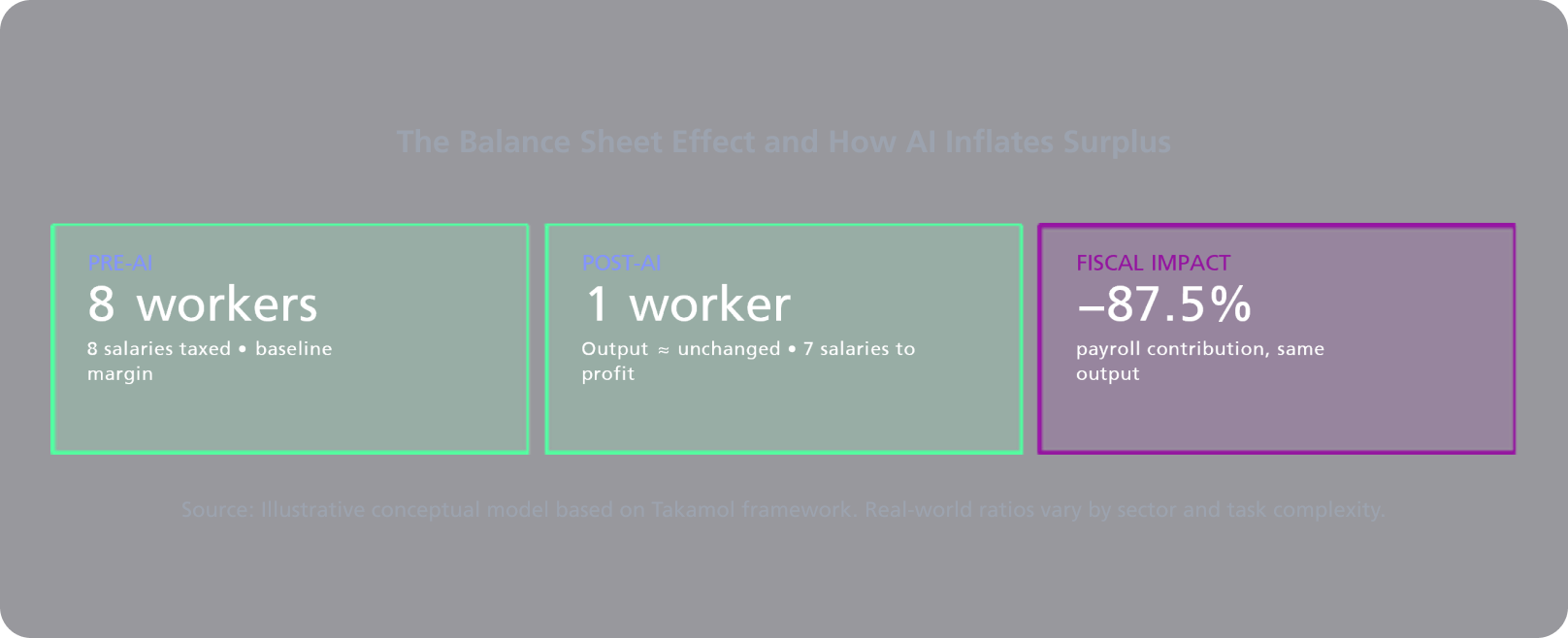
AI can raise productivity without preserving the payroll base that funds protection. Research in customer service and knowledge-work tasks finds substantial gains, although effects vary by worker and task. Consider an illustration in which one AI-supported worker produces what eight produced before: output can remain constant while seven salaries shift into profit, reducing payroll contributions by roughly 88 percent. This is not a forecast, but a balance-sheet example of the fiscal risk.[1] The ILO reports that labor's share of global income fell from 52.9 percent in 2019 to 52.3 percent in 2022 and has since remained flat.
Public measurement systems also struggle to capture how people work. Digital labor platforms record vacancies, skills, wages, and worker movements in close to real time, while public labor statistics still rely heavily on periodic surveys and categories built around one principal job. A person combining several short engagements can still appear simply as employed, concealing volatility, underemployment, and gaps in protection. When governments cannot see the transition clearly, every policy response is late and less targeted.
These changes require a coordinated response. The priorities were identified across three editions of the Global Labor Market Conference, drawing on almost 50 hours of recorded content, over 520 speakers, and participants from more than 100 countries. The six priorities below are designed to work together in a capability economy:
1. Establish skills as primary economic signals. Build the infrastructure that allows capability to move across employers and borders, including a shared skills taxonomy, a digital verification layer, portable skills records, adapted licensing rules, and employer co-investment in assessment. Singapore's SkillsFuture shows how this can operate at national scale; cross-border interoperability remains the main gap.
2. Treat workforce capacity as strategic infrastructure. Raise labor market planning to the level of fiscal and industrial policy, with cross-ministerial governance, durable funding, and active labor market programs that improve employment and earnings when designed well. Germany's Kurzarbeit short-time work scheme and dual vocational training system illustrate the approach.
3. Govern AI as a workforce multiplier. Treat the labor effects of AI as a direct object of policy through labor impact assessments, transparency requirements for hiring and management systems, real-time monitoring within labor ministries, and tax treatment that distinguishes augmentation from displacement. Training should also assume AI as a standard tool, as the EU AI Act and Saudi Arabia's SAMAI initiative indicate.
4. Align fiscal systems with capability-based economies. Shift the tax base from payroll toward value creation, using instruments already under implementation or debate: mandatory platform contributions, the OECD/G20 global minimum tax framework, earmarked transition funds, and international coordination. A broader value-creation levy remains at the design stage, while McKinsey estimates that generative AI could create $2.6 trillion-$4.4 trillion in annual economic value.
5. Design portable and adaptive protection systems. Attach protection to the worker rather than the job, through contributions prorated by hours or tasks, accumulation that moves across employers and borders, minimum contributions from every entity that engages labor, real-time tracking of entitlements, and safeguards that preserve accrued rights through transitions. Singapore's Platform Workers Act, France's Compte Personnel de Formation, India's Code on Social Security, and Saudi Arabia's Wage Protection System each implement part of this, though no country yet combines all five.
6. Build computational labor intelligence systems. Connect employment, skills, protection, education, and tax data into a real-time system governed by purpose limitation, independent oversight, algorithmic transparency, and rights of worker review. Saudi Arabia's Qiwa shows this direction drawing on a registry of 11.6 million contracts across 1.6 million establishments[1] to inform enforcement and policy.
The standard model worked because one stable job linked protection, revenue, and measurement, and each reinforced the others. The policy priority is to rebuild that alignment around the worker. These priorities are interdependent: a worker whose skills are unverified gains little from portable protection, and a fiscal system that cannot measure value cannot fund the transitions workers require. The capability economy needs the same fit between how work is organized, measured, governed, protected, and taxed, rebuilt around the individual rather than the employer. Delay will fall unevenly on younger and older workers, informal workers, and women. The work now is to connect reforms that still exist across separate institutions and systems.
[1] Authors' illustration. The example assumes constant output and an unchanged payroll-contribution rate. It is intended to illustrate how AI-driven productivity gains could reduce the payroll base, not to predict a specific employment outcome.
[2]Figures supplied by Takamol based on Qiwa administrative data.